Back in September, my wife and I went to Las Vegas. Since it was part-work/part-play, we switched hotels in the middle of the trip. One hotel was top tier (in my mind), which I will talk about in Part 2. The other was good. I would probably rate it a 7 on the 11-point scale. There was nothing WRONG with it. It was nice. I might even stay there again but I would not recommend it. In my mind, that is a 7 means. It got the job done, no complaints, but if we go back to Vegas, I would probably opt for trying something new, rather than going back there.
I am not going to name the hotel, but perhaps not for the reason you might think. Too often, in an effort to understand something, we need to create a narrative by defining and compartmentalizing it so we can evaluate it effectively. Sometimes this can be useful; it would be unfair to expect a 24-hour diner to serve four-star cuisine. But sometimes we draw these definitions in a way that allows us to downplay what the experience will teach us or degrade what an experience is. I had a friend complain to me that the Italian restaurants in Omaha were not as good as the Italian restaurants in Italy without self-identifying the idiocy of that statement.
Healthcare does this all the time. It will disregard stories from other industries because medicine is just different. We can’t learn from Ritz-Carlton or Starbucks because we have patients, not guests and are saving lives, not selling coffee. This can even bleed into other health systems. If I had a nickel every time someone said, “Yeah, but we’re not MAYO” implying that what they do won’t work here, well, I could probably get a Starbucks coffee.
This mindset is called Terminal Uniqueness. Long before it was in a Taylor Swift song, it is a way of justifying that one cannot learn anything from anywhere else, because the experiences are so different as to not apply. We have too many other variables in play, or budgetary restrictions, or governmental mandates that we are distinct from other businesses or hospitals and can’t use the same solutions that they use. You just don’t get it.
So, my concern is that if I name the hotel, your first response will be to pigeonhole the story and not identify what is useful. Some of you may already do that because, again, it isn’t healthcare, but the point of this story is for you to think about similar situations in your space rather than feeling smug or being dismissive thinking that “at least we are not that bad.”
My wife booked the room so we could be close to a part of Las Vegas that we have not explored very much in the past. The room was a suite, so it had a living room and kitchenette, separate from the bedroom. The bed was comfortable, room service was good and the shower was hot. So far, so good.
Early on the first morning, though, I noticed something with the coffee service. In the small kitchenette, on the bar counter sat the coffee maker. It was conveniently located right next to the sink, so water was not that far away. But there is one thing missing. Can you spot what is not there?

If you turn to the other side of the counter all we have is a light switch. Nothing there over there.
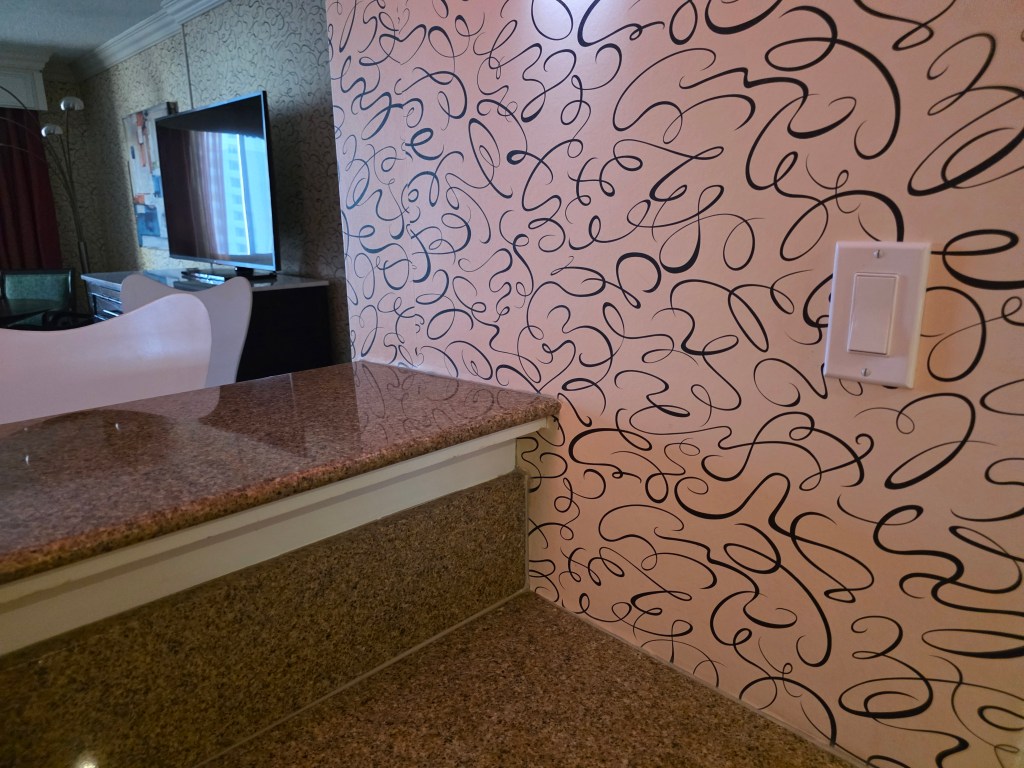
For those that have not cracked the code, there is no outlet to plug in the coffee maker. If you turned around in this space, where the mini-fridge was, there was a counter which would be a perfect place to use the coffee maker. There was ALSO no outlet. There was a half-bath right off the kitchenette and it had an outlet, but since it had a pedestal sink, there was no place to set the coffee maker down to use that outlet.
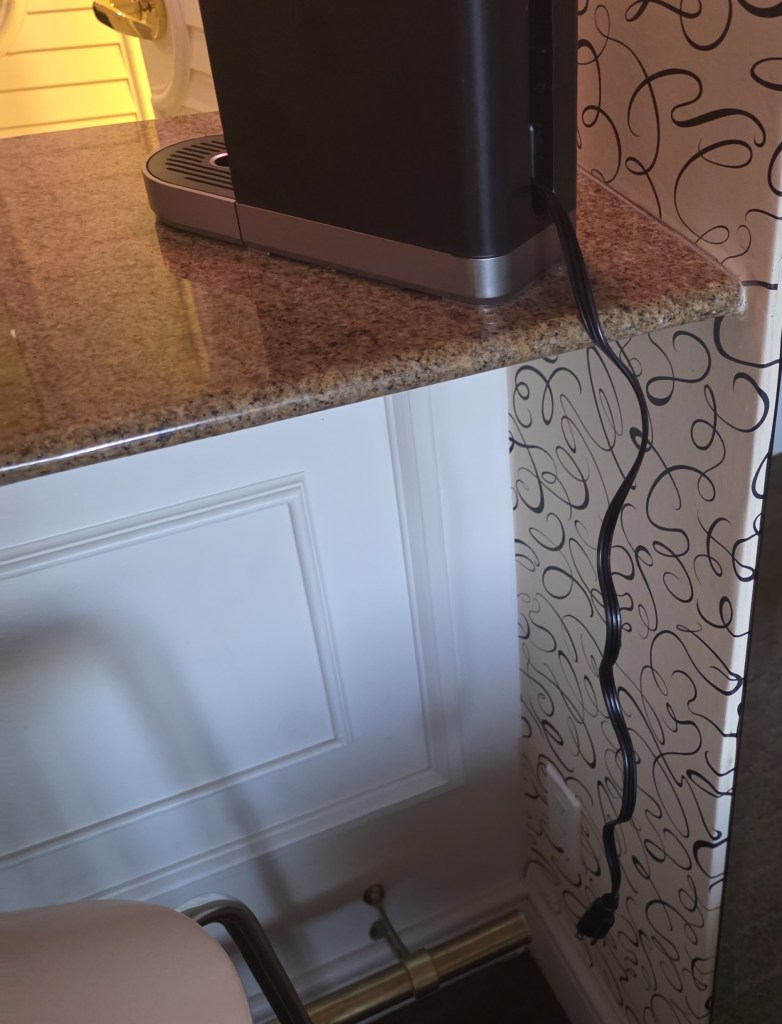
The closest outlet was on the other side of the bar where the coffee maker sat. The problem with this outlet was that the coffee maker cord would not reach the plug.

In fact, the plug would not reach the outlet even if I sat the coffee maker on one of the barstool seats next to the coffee maker. The only place with a flat surface next to a plug where I could use the coffee maker was the nightstand next to the bed. So, to brew morning coffee, I needed to either brew it while sitting on the floor, while balancing the coffee maker precariously on my luggage, or by moving the whole thing into the bedroom.
You can roll your eyes at the set-up in the room, or you can question my caffeine addiction. But the point of this story is to ask how often we create a benefit, but don’t consider how that benefit might be used? There are always going to be demands put on a customer or patient to use something. Afterall, in a best-case scenario, I still have to plug in the coffee maker, fill it with water, insert the pod and push the button. But when does this work become burdensome? Now, you can call me out in the comments if you think I am being overly demanding, since coffee was provided and I was able to make some. But observing that I WAS able to eventually make a cup of coffee misses the point. What does this say about the experience? When does a benefit cease to be a benefit? The issue here is that the hotel added a coffee maker because that is what hotel rooms have. But no one questioned how this would be used. As a result, any value of having coffee in the room was undercut by the fact that it was a pain to execute.
It feels like sometimes we are so focused on the outcome that we lose sight of the process. While in Las Vegas, I took a tour of a hospital’s short-stay unit, a unit designed to help with emergency department crowding and address the reality of some modern hospital stays. It was brand new and had a half-dozen beds. It had walls sectioning off the beds from each other and a curtain that could be pulled across the front to provide some privacy. Each bay had a small window with blinds. I was given the tour a couple of days before it would open and I observed a few issues. Not issues with its clinical functionality, but with its patient experience.
First was with the curtain that could be pulled for privacy. When pulled, it highlighted the fact that the bed was about eight inches longer than the depth of the bay, meaning that the curtain would tent over the edge of the bed. At the very least, when pulled, the curtain would make the small space feel claustrophobic, since that ‘wall’ would appear closer to the patient than the end of the bed. Second, to maximize the number of beds, a lot of the clinical needs—electricity, lines for the computer, oxygen, etc.—were hidden along the exterior wall. This meant that the window was about five feet off the floor and about a foot recessed from the bed. At six feet tall, I could reach the control to close or open the blinds, but anyone shorter than me would struggle to operate the blinds.
Neither of these things would compromise clinical care, but both undercut the implicit message of this space; your needs are important and we can easily manage anything you need right here. Are privacy and the ability to manage natural light really amenities if we have made them difficult to use comfortably?
Sometimes existing structures can limit retrofitting, and you have to do the best with what you can. One hospital’s structure prevented the outpatient care team from seeing the outpatient lobby and waiting room. So, they installed cameras so the clinical staff could easily see who was out there. A completely reasonable solution given the existing space. The problem was that there was no signage that would educate the patients. So, while the staff was confident to not overlook a patient, the patients were given no such assurance that they were not being forgotten.
Even that Short Stay Unit was created out of existing space. This means that there may have been limits to how much tailoring the space could be given to make it more user-friendly. But the patients only know that they cannot adjust the amount of morning sunlight they can get to offset the feeling like the walls are closing in on them.
That hotel kitchenette though is another level of attention (or inattention.) The hotel built that kitchenette. They needed to have it fit within a small space and could not afford too much elbow room. But adding an outlet on the counter does not affect the size of the space. Its absence indicates a lack of planning or a desire to cut costs. Me, the guest, doesn’t know which and doesn’t care. I only know that you made it harder to squeeze value and experience out of the hotel room.
Again, if you read all of this and think, “Wow, Las Vegas is a hot mess!” you are not picking up on the key point. Everyone reading this works in a space—clinical, administrative, personal—where design choices were made, some for functionality, some for ergonomics, and some for convenience. But putting a mini-fridge or a microwave in the break room is not enough, unless you question how this is being used. In short, providing one microwave for one hundred people is not seen as valuable by staff, if you have to schedule a time to microwave your lunch.
 PX Matters with Joseph Snipp
Leave a comment