Last week, I wrote about patient comments and promised another essay on how to use patient comments effectively. I was distracted this weekend, though, by a Buzzfeed clickbait list and I thought I would try something different. I will return to patient comments on Wednesday, but the Buzzfeed list in question on “unhinged patient complaints” as reported by doctors posed too interesting/annoying/patronizing to be ignored. As I read them, I thought that they might be unhinged, but they might also simply illustrate that clinicians don’t communicate effectively or assume that patients have more knowledge than they should be expected to have. To that end, I will provide the potential patient’s perspective on these observations to show that they may not actually be unhinged, but simply two people seeing the same thing and interpreting it differently. There are 21 of them and I won’t respond to each one, but I will post a link to the list in the end notes for those interested in reading them all.
Before beginning, let me state that I can see that some of these comments can be borne of behavioral health or intense stress by patients or family, but my intention is to take them at face value, at least where reasonable.

OK, am I the only one who needs to see this blinking? This illustrates, though, a theme through these posts, of potentially not calling out the obvious thing in the room. In this case, I have talked to thousands of clinicians, and I am hard-pressed to remember anyone who blinked in such an odd manner as to be noteworthy. So either this patient was struggling with behavioral health issues (which were not called-out by the doctor), or you were having a bad blinking day. As I write this, I am in Chicago (not a flex but explains why I am posting so late on a Monday), and there is something in the air that has been drying out my eyes, so I have occasionally been having very pronounced blinks verging on squints, to prevent me from rubbing them. My wife saw me do this and asked if I was OK and I explained. She expressed empathy and we moved on.
In many care settings, once the bleeding stopped, that doctor and the words they are saying are the thing a patient focuses on. But, if the doctor behaves in a non-standard way—fidgeting, mumbling or stumbling over their words, seeming distracted, or exhibiting nonstandard blinking—it is magnified in the that patient’s focus on your communication. If you have anything that could be distracting, like a bad allergy day, call it out so the patient is not distracted by this behavior and can focus on what you are saying.
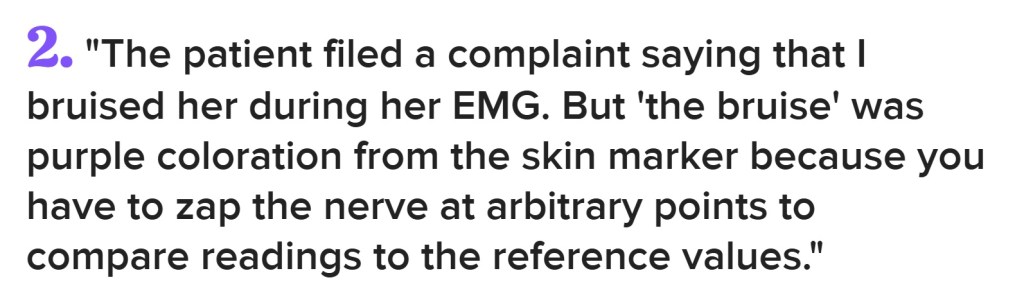
So, you put ink on a patient without narrating care, didn’t try to remove it, nor did you call this out that she could remove as you were discharging her. And you are mad that she didn’t know the proper protocol for this test? Perhaps you should have this patient’s license suspended.
Often clinicians will get irritated by people telling them that they should narrate care when the clinician thinks that the patient is actively watching them work. But while people will be laser-focused on a provider (see above), when they are getting something done—a blood draw, setting a line, taking an MRI, or taking an EMG—they are more focused on the big machine, the possibility of pain, or broader concerns about mortality than they are focused on you marking up their arm. Add to this that the average patient does not have “sharpie pen” in their mental toolbox of medical devices.
Instead of assuming that a patient knows what you are doing, you could narrate the reason why you are marking up their arm and when finished tell a patient the best way to get the ink off of their arm. At the very least, if you asked the patient if they had any questions, they might have asked you about it. Please don’t get mad at a patient for not knowing that you inked up their arm, since, you know, it is their first day here.
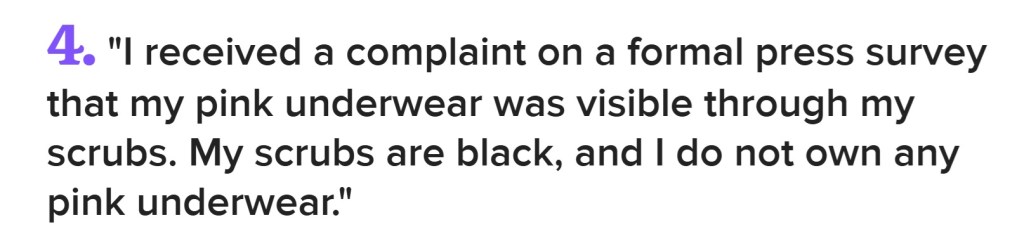
Patient confusion should not be mistaken for the lack of a useful observation. The patient encounters many people on their care team, so either they saw this and misidentified you, or you assumed that the comment made in the survey was about you and it wasn’t. Like so many things on this list, it seems way too specific to be a falsehood, so I am tending to believe that the patient saw it, even if it wasn’t the person they thought it was. Chances are, depending on the size of the unit or clinic, you know who the person is, who often pays little attention to the clothes they wear. You can roll your eyes and say, “patients be crazy” or you could have a conversation with the oblivious staff member, since they may be embarrassed or surprised that someone noticed.
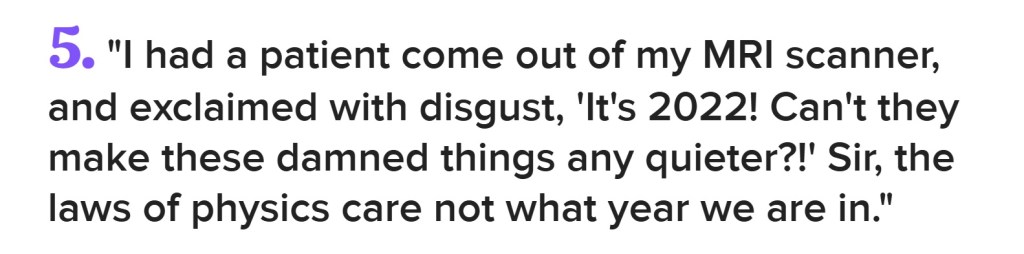
Ha, ha! Patients be stupid! Last time I checked, MRI machines use magnets and radio frequency pulses, neither of which are known in the civilian world as being noisy, so expecting a patient to understand this is patronizing. Setting aside that, MRIs have a reputation for being claustrophobic spaces where one must sit perfectly still for extended time, while the machine makes various random groans and whines. My guess is that this patient was anxious and made the comment to seek reassurance that the noises the machine made were normal or expected. Narrating care and calling out the noise in advance would be helpful to avoid comments like this in the future. Again, don’t expect that patients will have more experience with the machine or the test than you do.
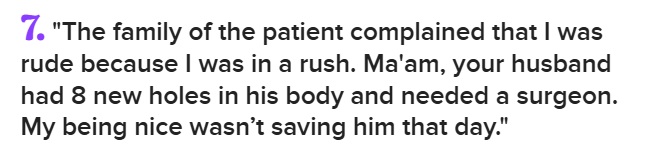
A classic, “I am here to save your ass, not kiss your ass” comment. If the gurney is coming in hot from the ambulance, yeah, I can imagine that you have other things on your mind. If you are looking for patient consent for a procedure that is time-dependent, though, a quick, “I am not trying to be rude, but we don’t have a lot of time here…” can go a long way to redirect the family member’s panic. Because I am sure that no clinician has ever approached a gunshot victim or drug overdose with any ‘blame the victim’ mentality that might be present and interpreted as rude by family members.
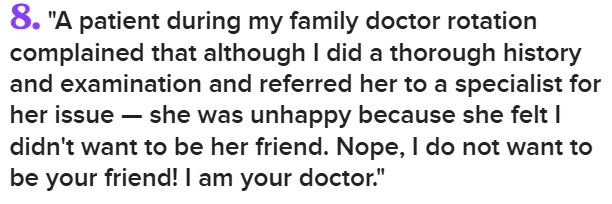
This was the comment that inspired this essay. You are a family doctor. It IS your job to be their friend. Not, margaritas-on-a-Friday-night kinda friend, but a friendly face that a person can open up to. As a family practice doctor, how are you going to talk about sensitive topics like sexually-acquired infections or why this five-year-old is in the office having shoved a bean up their nose for the third time this month, if you cannot establish a rapport with a patient. Being a family practice or general practice doctor is as much about mystery-solving as it is about healing. So creating a broad friendship-type conversation with them will make it easier to have difficult or embarrassing questions.

Depending on the context of this written complaint (comment made on a survey versus a letter written to the CEO), this may simply be a broad comment about the state of the facility. While you may think that this is outside of your control, patients are making judgements about the care they will receive before they receive it and a dirty parking lot, or a dusty vent, or a water-stained ceiling tile is what people use to fill in the gaps on what kind of care they will receive. Have you looked at the state of your parking lot? Are there one or two cigarette butts, or are there hundreds? As this is the first impression your patients are getting, perhaps it should be a concern for facilities management to address.
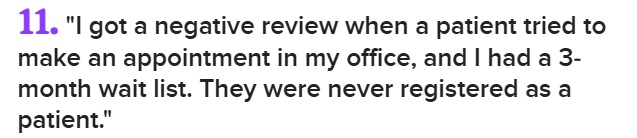
If they could not get an appointment for three months, they have been trying to establish care with you and NOT already be a registered patient. Again, context matters, but if access is such a problem as to drive patients to other doctors, you should not simply dismiss this comment. You don’t know WHY they are not registered patients. I worked for a hospital system that would cancel appointments, often with little notice to the patient, if they were self-pay or listed an insurance that was no longer in-network. Given the games insurance companies and hospital systems play, patients can often be the last to know that they are no longer in-network. Trust me when I say, getting AND KEEPING an appointment is more difficult for your patients than you realize.
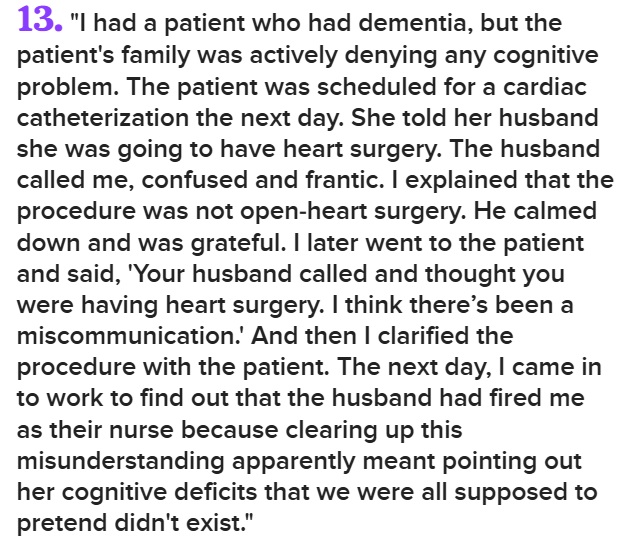
There is certainly more to this story than I can see. If patient was competent to make their own informed consent, then explaining it in a way that the patient can understand is critical. If they don’t understand it then it is on you to try again. If the husband was their medical power of attorney and you were clarifying it to the patient to prevent further confusion, that is also sensible. Either way, a simple clarification of the procedure does not seem outrageous. So, the complainant was being motivated by motives too numerous to speculate, or, there was something in the way you had the conversation. I cannot comment about the first part, but often what you call clear explanation can come off as patronizing to your audience.
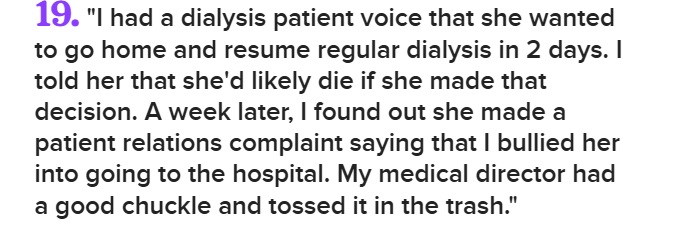
Telling a patient that they will die is not having a conversation about treatment options and consequences. One of my biggest pet peeves in communication is the sentiment that honesty trumps all other considerations. That is, people saying, “I was just being honest” when they say you have a stupid haircut or have ugly clothes. The patient was highly anxious and wanted to go home. A sentiment we can all understand. But saying, “Sure, you can go home… and you will die” is not simply ‘being honest.’ I would feel bullied in that situation as well, if no one explained why this was the case.
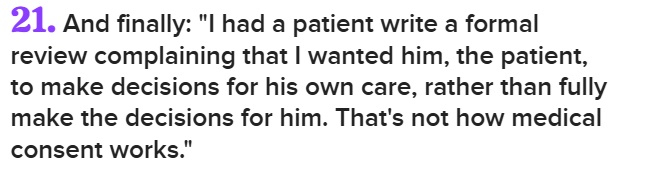
Clearly there was miscommunication here. While ideally every decision is made as a team, what that team looks like and operates like varies from case to case. Clearly, the patient here was looking for more education and guidance. You cannot get mad at patients who want to challenge your knowledge based upon random web searches and then get mad at a patient who is confused about what the options mean and says, “whatever you think is right, doc.”
OK this was fun. I will have to do something like this again some time. If you come across anything like this or have some other list you want me to comment on, please let me know.
Our regularly scheduled programming will return on Wednesday.
Oh, and since I promised it, here is the link to the original source material.
https://www.buzzfeed.com/jennifer_mcphee/medical-professionals-share-most-ridiculous-complaints
 PX Matters with Joseph Snipp
Leave a comment