Before I start, a rare peek behind the curtain. Yes, I am publishing these essays out of order. It is because I am writing them out of order. Most of the multi-part essays I write start out as one essay only for me to realize that they really need to be two essays. In this case, three essays. This may make sense, but you still might still wonder why I don’t just call this Part 2. Because Part 2 is more in-line with Part 1, as elements of math that people find confusing. This essay seeks to be a less math-forward essay about how we function as humans, both on our best days and our worst days. This essay, then, deserves to be either first or last, and since it isn’t first, it must be last. At this point some of you may realize that I have either undiagnosed ADHD, or I am on the spectrum, or that at times I have a spider monkey hopped up on caffeine careening around my head. I have no evidence of these diagnoses, but I will also not fight any of those assumptions.1
At the center of how people struggle with processing math, there is one core issue that makes this comprehension difficult. People struggle wrapping their head around big and small numbers. The bigger or smaller, the worse we are at understanding them. This is not about how stupid people are. A vast majority of people struggle with this. Those who don’t struggle with big numbers generally don’t because they have been trained (or trained themselves) to be more aware of the issues surrounding big and small numbers. These are not healthcare-specific issues, but they do carry healthcare literacy ramifications. Healthcare is built upon probabilities, survival curves, expected mortality rates, length-of-stay calculations, etc. But if we struggle to contextualize these numbers, they end up having little meaning. What is worse is how we tend to fill that knowledge gap.
In my essay on interval scales, I made the point that people do not process the world in an interval fashion. We can rank things; in fact, we love to rank things. By my calculation, 76%2 of social media posts are on ranking music, movies, people, cars, generations, cocktails, restaurants, worst fashion trends, best ways to save money, etc.3
We can also balance our checkbooks4 if we want to. We can calculate how much drywall we need to panel a room. We do understand numbers and can use them. But for most of us, there is a number beyond which everything gets classified as BIG. Back in 2000, Alex Rodriguez signed a $252 million contract (biggest at the time) to play baseball and then signed a $275 million contract with the Yankees a few years later. Nineteen years after that, Shohei Ohtani signed a $700 million contract with the Dodgers. Some may be outraged that people get paid so much to play a game, but otherwise, these are just big numbers just wash over us, as “more money than I will ever make.” If asked to explain why Shohei’s number is bigger, we might attribute it to inflation between 2004 and 2023, not really calculating whether that is really the reason for the difference. [Spoiler alert: It isn’t. An inflationary increase would have A-Rod’s $275 million in 2004 translate into $485 million in 2023. So, Ohtani’s contract is not just bigger because of 19 years, but because it really is bigger.]
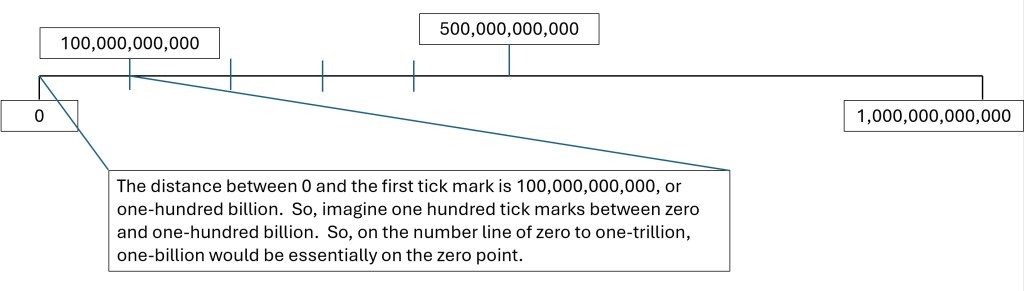
When I was teaching political science and was talking about budgets, spending, deficits, I would say that these numbers really had very little meaning to most people. Even if people got outraged at the size of the deficit and would rail against spending for this project or that project, people had no idea what impact Project X had on Budget Y. I would illustrate this by drawing a number line on the board, from zero to one trillion. I would then invite class members to the board and mark where they thought one billion was. Take a moment and consider this puzzle.

In twenty years of teaching, I had a couple of people get close and one person get it right. But a vast majority were way off. Below, you see how I would demonstrate the answer by inserting easy midpoints and then paring down the line into sections. When I asked how that one student got the right answer, they admitted to doing exactly what I did in their head.
The point of this exercise was not to say people shouldn’t care about deficits. It is that, at some point, large numbers have no meaning. If you think the road to a balanced budget is by firing Big Bird or Nina Totenberg, you really don’t have a good sense of what those programs cost or how big numbers work.5 Or, as Senator Everett Dirksen said, “a billion here, a billion there, and pretty soon you’re talking about real money.”6 In reality, though, talking of a billion here and a billion there, it stops being real money to most people.
The reverse is also true. Small numbers have no meaning for most people. An obvious example of this is the chances of winning the lottery. Whether you structure the chances of winning as 1:292,201,338 or as in a 0.000000002423% chance, these numbers mean nothing to people. Sometimes, to help people comprehend these numbers, others will provide some sort of context. But even these contexts don’t mean much.
For example, if you bought a Powerball ticket every week from the week you were born, you would still have to live to be 5.6 million years old before you would likely be a winner. Or, your chances of getting attacked by a shark are only 1:4.3million. So, you have a greater likelihood of getting attacked by a shark 67 times than winning Powerball once. None of these numbers make sense because they are often random and because creating a slightly smaller number by comparing two really big numbers doesn’t really help with processing. So after all these numbers, people still buy lottery tickets.
This inability to process big numbers is compounded by two additional facts.
- First, we are generally bad at knowing the odds of anything. We generally over-estimate or under-estimate the chances of something happening. People will overestimate the impact on drunk driving on vehicular deaths and underestimate the impact of distracted driving on vehicular deaths. Even though, both account for approximately the same number of vehicular deaths. Another example is that many people will guess that the odds that a high school athlete will play in the NBA or NFL is about 1:10,000, since the player needs to attract the eye of a college scout, excel in college, and then attract the eye of any NBA or NFL scouts while competing for a job against a bunch of athletes who already play professionally. But the reality is that odds are a lot smaller: 1:1250 for high school to NFL and 1:3333 for high school to NBA.
- Second, we are often over- or under-estimate any social or behavioral preconditions to the odds. Certainly, you can have a marked impact on your odds of an event occurring by your choices and behaviors. Your odds of getting struck by lightning each year are 1:1.5million and you can improve those odds by going inside during a storm. The odds of suffering from a shark attack are 1:4.3million. During a spate of shark attacks one summer, my hometown paper, the Omaha World-Herald, ran a front-page story listing the Best Ways to Avoid Shark Attacks and imagine my surprise that “Live in Omaha, NE” wasn’t the number one way. To the best of my knowledge, there has NEVER been a reported shark attack, let alone fatality, in the history of Nebraska. The tourism board should probably lead with that fact.7 In a less cheeky example, people will assume smokers get lung cancer, so don’t smoke and you won’t get lung cancer. But this is not true. Lifetime mortality for a smoker to lung cancer is 1:882, but for a nonsmoker lifetime mortality to lung cancer is still 1:5,682. So, a smoker is six-times more likely to die of lung cancer than a non-smoker, but I bet that 6x doesn’t seem like that big of a difference to many of you. People automatically assume that they can escape the fickle finger of fate by living right. Don’t get me wrong, you can improve your odds in certain situations, but you cannot reduce them to zero.8
So not only do we not know the odds of anything, but we also think we can control those odds. Depending on your psyche this means that you either think that you can control fate, or you fear that you will tempt fate. Whether you call this anthropomorphizing fate, or main character syndrome, we tend to filter all we see and know through our own biases and feelings of luckiness or unluckiness. This feeling that “This will never happen to me!” or “It always happens to me!” fuels our perception of the odds associated with any action. I could write an essay on why people always feel like they only hit red lights when they are in a hurry, but for the moment, I think many people reading this will feel this as true.
I once had a stats professor who had an interesting way of illustrating this tendency to personalize randomness. He would always start his lecture on probability by bringing a lottery ticket for the next drawing into class, writing the numbers on the board, and then dramatically burning the ticket. [Smoking is bad, but, oh, the days when everyone had a lighter in their pocket.] The class would gasp and make the usual protestations about, “But what if?”9 The point of this demonstration was not that the odds are microscopic, though. We were in a statistics class and we already knew this. The point was the response that this act generated in us, the class. We were all statisticians, we all knew the probability, but we all still were imagining the worst-case scenario. I mean, the odds are functionally zero, but they are not actually zero. Whether the emotion was fear (What if it hits!?!) or schadenfreude (I hope it hits, that will show him!), this act said more about who we were than what we knew about the probability.
Humans know almost nothing about probability, but we all have strong opinions about what probability does to us. But probability doesn’t care what it does to us. It doesn’t care about your desire to win the lottery or not have cancer. Heck, saying that probability cares about anything anthropomorphizes a math equation. We ascribe values of goodness, fairness or justice to it, expecting it to produce positive outcomes.
The visceral response that burning lottery ticket had on me, has carried me through a lot of healthcare conversations, both theoretical and actual, and is a useful metaphor. The doctor is the one speaking in objective facts and probabilities, metaphorically setting the lottery ticket aflame to illustrate a scientific point. The patient confronted with the possibility of a disease, is watching the lottery ticket burn, thinking about how the universe will make them—doctor and patient—pay for their hubris in trusting the math.
Patients are not framing the conversation in terms of large numbers or small numbers. They are not rationally considering the real-world odds of the worst-case scenario. They know that the worst-case scenario is worse than any other scenario in any other aspect of their life. For them, it is not about large numbers or small odds. It is only about one number. One. Them. Alone. Winning the only lottery that they will ever win even though they did not want to play.
In my life working with healthcare numbers and statistics, I reviewed a lot of electronic health records. To be clear, not as a voyeur. It is just surprising how little data is hard-coded and how much needs to be mined line-by-line. I was once working on a hospital’s ability to seamlessly transition patients into hospice and whether this was easier or more difficult to transition them into an in-network hospice facility versus an third-party hospice facility. The EHR would designate a patient as ‘discharged to hospice’ but I had to go into the record and read the notes to determine WHERE they were being sent. In this research, I read a note about an elderly man whose wife had just beaten cancer, and they were planning how to spend the rest of their lives traveling the world, only to discover that he had terminal cancer and was not likely to survive the year. He said that this was not fair and couldn’t imagine how this was possible. When I talk to doctors about how to talk about probabilities and possibilities, I will sometimes reference this story. That man is not curious about the odds of this happening, or how unusual (avoiding the word “lucky” here) this outcome was. He was not interested in any of that. He could only see that he did not have the energy to start a new fight, especially a new fight against the same fucking villain they had already beaten.
This goes beyond any concern about our ability to process numbers or chances or likelihoods. It isn’t about beating the long-odds because “you got to be in it to win it.” It isn’t about seeing the glass half-full or half-empty. You might expect optimism or bravery, but don’t expect any patient or family member to be rational about it. Humans are not structured that way.
1I think a good gauge of how much spider monkey activity goes into any essay is the number of endnotes the essay has. This one is shaping up to be a doozy.
2Clearly a number I pulled out of the air, though, I bet that number feels right.
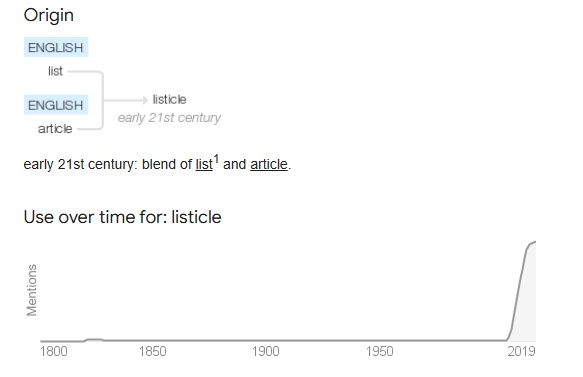
3Heck, the fact that “listicle” (a piece of writing or other content presented wholly or partly in a form of a list) is in the OXFORD DICTIONARY proves my point. On a side note, nothing gives me more odd pleasure watching a dictionary struggle to give august weight to the word origins of portmanteaus.
4I will take a moment here so all of you over the age of forty explain to all of you under the age of forty what a “checkbook” is.
5This is not meant as a defense of public television or public radio. My opinions on that as well as just about any other political conversation will remain undiscussed. I merely point out that our deficits have grown way beyond a simple nip and tuck.
6Some say that Tip O’Neill said this, but it has been widely misattributed to him. IN all honesty, this includes me, as I almost gave him credit before verifying the quote.
7Now my paleontology friends would point out that about 90 million years ago, Nebraska was covered with an ocean, so where there is ocean, there is the possibility of sharks. Of course, homo sapiens did not appear until 300,000 years ago, so while there may have been ancestors to modern-day sharks swimming across what would be Nebraska, it would have been impossible for them to eat humans. For those curious, this is what nerds think about when they think no one is around.
8Of course the fatalist’s response of “I could do everything right and get hit by a bus tomorrow” is true, but unlikely, since the odds of you getting hit by a bus are only 1:3.2million. Plus, given the average speed of a bus, it is unlikely to kill you, even if you do get hit.
9For the record, in all his years with this demonstration, he never lost out on a big (or small) prize.
 PX Matters with Joseph Snipp
Leave a comment